


Colon suis-Injeel Ampoules
Description
Indications
Colon suis is traditionally associated with disorders of the large intestine and with supporting the regulation of intestinal function and of the intestinal flora. It is linked with enterospasms — particularly at the splenic flexure (flexura lienalis) and the sigmoid colon — and with intestinal colic, intestinal stasis and intestinal tenesmus (painful straining). It is connected with colitis mucosa et ulcerosa (mucous and ulcerative inflammation of the colon) and, through its detoxifying role, is often reached for as an intermediate remedy or at the very start of treatment where the toxin burden is considered serious. Its action is regarded as similar to that of Coecum suis-Injeel but more powerful. Among general complaints it is also traditionally associated with insomnia.
About the remedy
Colon suis-Injeel is a single-remedy homeopathic preparation from Heel's antihomotoxic Injeel range, prepared from potentised porcine (suis) colon tissue. In line with the principle of suis-organ preparations, a potentised animal organ is used to support the corresponding human organ — here the colon, or large intestine — encouraging its own regulation, motility and detoxifying function within antihomotoxic therapy.
Composition
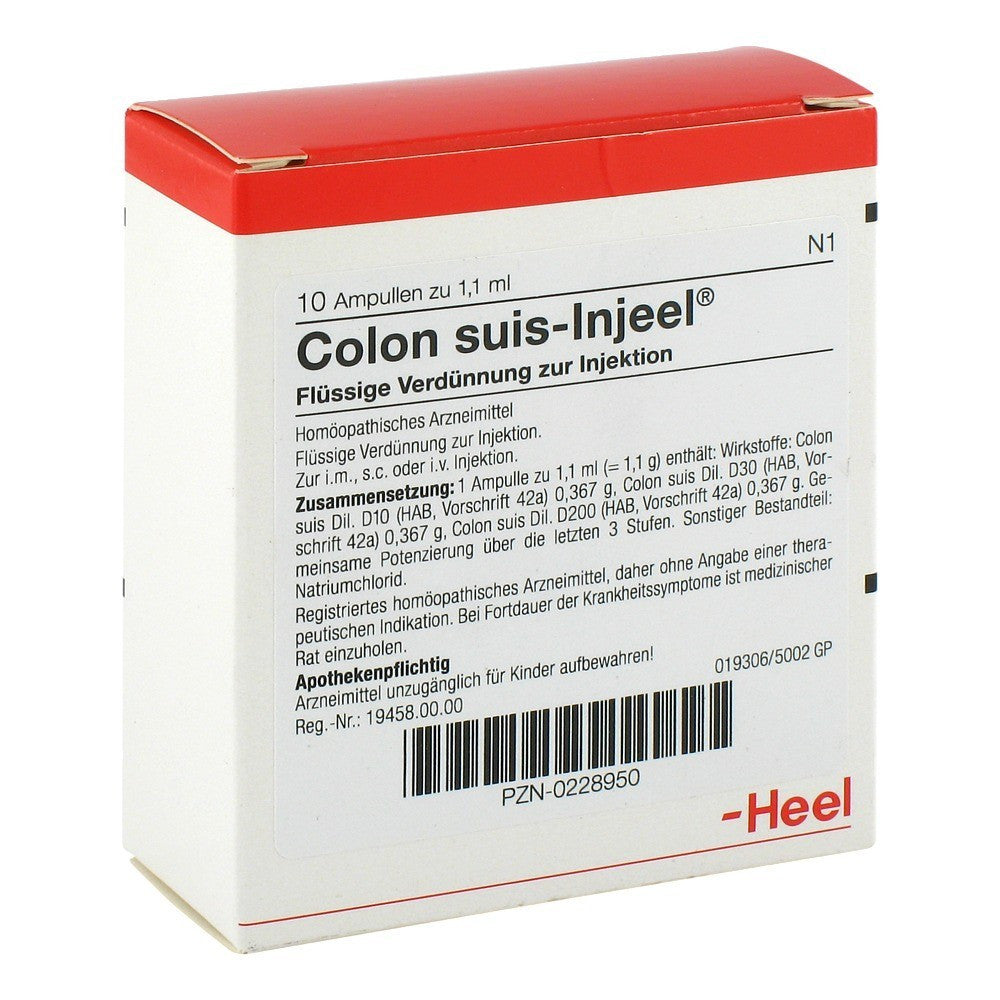
Each 1.1 ml ampoule contains: Colon suis D10, D30, D200 — 0.367 ml each.
Part of the Heel range — what to use it with
Among the preparations stocked here, Colon suis features in the complex remedy Hepar Compositum. In injection therapy it is frequently combined with Hepar suis-Injeel, and it is often given alongside Nux Vomica Injeel S to support intestinal function and detoxification.
Suggested use
Supplied as ampoules of 1.1 ml. The solution may be taken orally or used by injection (i.m., s.c., i.d. or i.v.). A general guideline is the contents of one ampoule 1–3 times weekly; in acute situations it may be used more frequently, or as directed.
Description
Indications
Colon suis is traditionally associated with disorders of the large intestine and with supporting the regulation of intestinal function and of the intestinal flora. It is linked with enterospasms — particularly at the splenic flexure (flexura lienalis) and the sigmoid colon — and with intestinal colic, intestinal stasis and intestinal tenesmus (painful straining). It is connected with colitis mucosa et ulcerosa (mucous and ulcerative inflammation of the colon) and, through its detoxifying role, is often reached for as an intermediate remedy or at the very start of treatment where the toxin burden is considered serious. Its action is regarded as similar to that of Coecum suis-Injeel but more powerful. Among general complaints it is also traditionally associated with insomnia.
About the remedy
Colon suis-Injeel is a single-remedy homeopathic preparation from Heel's antihomotoxic Injeel range, prepared from potentised porcine (suis) colon tissue. In line with the principle of suis-organ preparations, a potentised animal organ is used to support the corresponding human organ — here the colon, or large intestine — encouraging its own regulation, motility and detoxifying function within antihomotoxic therapy.
Composition
Each 1.1 ml ampoule contains: Colon suis D10, D30, D200 — 0.367 ml each.
Part of the Heel range — what to use it with
Among the preparations stocked here, Colon suis features in the complex remedy Hepar Compositum. In injection therapy it is frequently combined with Hepar suis-Injeel, and it is often given alongside Nux Vomica Injeel S to support intestinal function and detoxification.
Suggested use
Supplied as ampoules of 1.1 ml. The solution may be taken orally or used by injection (i.m., s.c., i.d. or i.v.). A general guideline is the contents of one ampoule 1–3 times weekly; in acute situations it may be used more frequently, or as directed.