


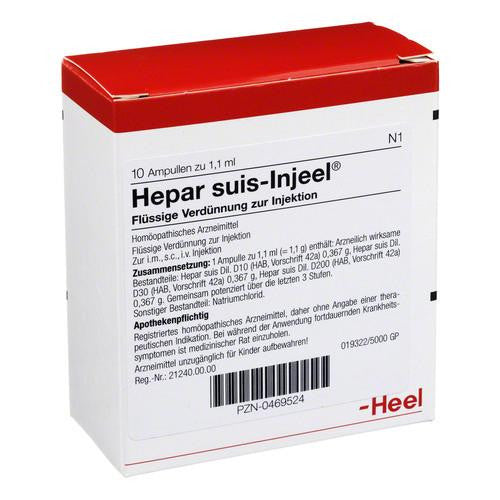
Hepar suis-Injeel - Ampoules
Description
Indications
Hepar suis is traditionally associated with support of the liver and with stimulation of the detoxicating hepatic function, and is used for a damaged liver and deficient hepatic detoxication. It is linked with a range of chronic skin conditions — chronic eczema, neurodermatitis, psoriasis, erythematosus and porphyria — as well as with dermatomycosis, pemphigus and kraurosis vulvae. It is further connected with male sterility, radiation sickness, hypoglycaemia and anorexia nervosa, and is frequently indicated as an intermediate remedy in cellular phases. Reflecting the liver's role in metabolic disease, it is also associated with arthrosis deformans and periarthritis humeroscapularis.
About the remedy
Hepar suis-Injeel is a single-remedy homeopathic preparation from Heel's antihomotoxic Injeel range, prepared from potentised porcine liver tissue (Hepar suis). As a suis-organ preparation it is used according to the organ-therapy principle to support the corresponding human organ — here the liver — and to encourage its own detoxicating and regenerative function.
Composition
Each 1.1 ml ampoule contains: Hepar suis D10, D30, D200 — 0.367 ml each.
Part of the Heel range — what to use it with
Hepar suis appears across the Heel range; among the preparations stocked here it features in Hepar compositum, Cerebrum compositum, Cor compositum, Cutis compositum, Rauwolfia compositum, Thyreoidea compositum and Tonsilla compositum. In liver-directed injection therapy it is often combined with Hepeel, Injeel-Chol and Chelidonium-Homaccord to stimulate the detoxicating hepatic function.
Suggested use
Supplied as ampoules of 1.1 ml. The solution may be taken orally or used by injection (i.m., s.c., i.d. or i.v.). A general guideline is the contents of one ampoule 1–3 times weekly; in acute situations it may be used more frequently, or as directed.
Description
Indications
Hepar suis is traditionally associated with support of the liver and with stimulation of the detoxicating hepatic function, and is used for a damaged liver and deficient hepatic detoxication. It is linked with a range of chronic skin conditions — chronic eczema, neurodermatitis, psoriasis, erythematosus and porphyria — as well as with dermatomycosis, pemphigus and kraurosis vulvae. It is further connected with male sterility, radiation sickness, hypoglycaemia and anorexia nervosa, and is frequently indicated as an intermediate remedy in cellular phases. Reflecting the liver's role in metabolic disease, it is also associated with arthrosis deformans and periarthritis humeroscapularis.
About the remedy
Hepar suis-Injeel is a single-remedy homeopathic preparation from Heel's antihomotoxic Injeel range, prepared from potentised porcine liver tissue (Hepar suis). As a suis-organ preparation it is used according to the organ-therapy principle to support the corresponding human organ — here the liver — and to encourage its own detoxicating and regenerative function.
Composition
Each 1.1 ml ampoule contains: Hepar suis D10, D30, D200 — 0.367 ml each.
Part of the Heel range — what to use it with
Hepar suis appears across the Heel range; among the preparations stocked here it features in Hepar compositum, Cerebrum compositum, Cor compositum, Cutis compositum, Rauwolfia compositum, Thyreoidea compositum and Tonsilla compositum. In liver-directed injection therapy it is often combined with Hepeel, Injeel-Chol and Chelidonium-Homaccord to stimulate the detoxicating hepatic function.
Suggested use
Supplied as ampoules of 1.1 ml. The solution may be taken orally or used by injection (i.m., s.c., i.d. or i.v.). A general guideline is the contents of one ampoule 1–3 times weekly; in acute situations it may be used more frequently, or as directed.