


Neuro Injeel - Ampoules
Description
Indications
Neuro-Injeel is traditionally associated with psychosomatic and masked psychosomatic disorders, and in particular with depressive conditions. Through its individual constituents it is linked with physical and mental exhaustion, neurasthenia and psychasthenia, poor memory, melancholia and apathy, and with nervous restlessness and insomnia. It is connected with hysterical states and globus hystericus, with agoraphobia, and with lability of mood, tearfulness and migraine. It is further associated with vegetative dystonia, climacteric neurosis and depression, and with the alleviation of withdrawal symptoms during detoxication from nicotine or alcohol. It has also been used for disturbances in the mental development of children and, with companion remedies, as an adjunct in endogenous psychosis.
About the remedy
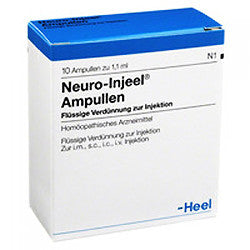
Neuro-Injeel is a combination homeopathic preparation from Heel's antihomotoxic Injeel range, uniting potentised remedies with a long standing in nervous and psychosomatic complaints — Acidum phosphoricum, Argentum nitricum, Platinum metallicum, Sepia officinalis, Valeriana officinalis, Avena sativa and Ignatia. Together they address mental and physical exhaustion, depressive and anxious states, and nervous unrest.
Composition
Each 1.1 ml ampoule contains: Acidum phosphoricum D10, D30; Argentum nitricum D10, D30; Platinum metallicum D10, D30; Sepia officinalis D10, D30; Valeriana officinalis D10, D30 — 1.1 µl each; Avena sativa D10, D30; Ignatia D10, D30 — 2.2 µl each.
Part of the Heel range — what to use it with
Among the preparations stocked here it is frequently supported orally by Nervoheel and, for diminished capacity in children, by Lymphomyosot, Calcoheel and Hormeel S; in the climacteric it is combined with Klimakt-Heel and Ovarium suis-Injeel. In more severe states it is given alongside Engystol N, Traumeel S and Hepar suis-Injeel, and in injection therapy it is often paired with Cerebrum suis-Injeel.
Suggested use
Supplied as ampoules of 1.1 ml. The solution may be taken orally or used by injection (i.m., s.c., i.d. or i.v.). A general guideline is the contents of one ampoule 1–3 times weekly; in acute situations it may be used more frequently, or as directed.
Description
Indications
Neuro-Injeel is traditionally associated with psychosomatic and masked psychosomatic disorders, and in particular with depressive conditions. Through its individual constituents it is linked with physical and mental exhaustion, neurasthenia and psychasthenia, poor memory, melancholia and apathy, and with nervous restlessness and insomnia. It is connected with hysterical states and globus hystericus, with agoraphobia, and with lability of mood, tearfulness and migraine. It is further associated with vegetative dystonia, climacteric neurosis and depression, and with the alleviation of withdrawal symptoms during detoxication from nicotine or alcohol. It has also been used for disturbances in the mental development of children and, with companion remedies, as an adjunct in endogenous psychosis.
About the remedy
Neuro-Injeel is a combination homeopathic preparation from Heel's antihomotoxic Injeel range, uniting potentised remedies with a long standing in nervous and psychosomatic complaints — Acidum phosphoricum, Argentum nitricum, Platinum metallicum, Sepia officinalis, Valeriana officinalis, Avena sativa and Ignatia. Together they address mental and physical exhaustion, depressive and anxious states, and nervous unrest.
Composition
Each 1.1 ml ampoule contains: Acidum phosphoricum D10, D30; Argentum nitricum D10, D30; Platinum metallicum D10, D30; Sepia officinalis D10, D30; Valeriana officinalis D10, D30 — 1.1 µl each; Avena sativa D10, D30; Ignatia D10, D30 — 2.2 µl each.
Part of the Heel range — what to use it with
Among the preparations stocked here it is frequently supported orally by Nervoheel and, for diminished capacity in children, by Lymphomyosot, Calcoheel and Hormeel S; in the climacteric it is combined with Klimakt-Heel and Ovarium suis-Injeel. In more severe states it is given alongside Engystol N, Traumeel S and Hepar suis-Injeel, and in injection therapy it is often paired with Cerebrum suis-Injeel.
Suggested use
Supplied as ampoules of 1.1 ml. The solution may be taken orally or used by injection (i.m., s.c., i.d. or i.v.). A general guideline is the contents of one ampoule 1–3 times weekly; in acute situations it may be used more frequently, or as directed.