


Hepar sulfuris Injeel Ampoules
Description
Indications
Hepar sulfuris is traditionally associated with a marked tendency towards suppuration, especially of the skin and lymph glands — furuncles, pyodermia, whitlows and phlegmons — together with cellulitis and general pus formation. It is linked with tonsillar abscesses, chalazions and hordeolums (styes), and with a right-sided haemicrania (one-sided headache). In the urinary sphere it is connected with urinary disorders, cystopyelitis and pyuria. Characteristic of the picture is a great sensitivity to touch and pressure, a pronounced hypersensitivity to cold and draughts, and improvement through moist warmth such as warm compresses; the discharges may have an odour reminiscent of stale cheese.
About the remedy
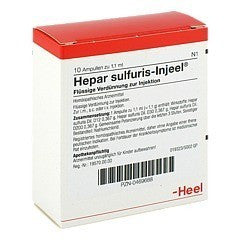
Hepar sulfuris Injeel is a single-remedy homeopathic preparation from Heel's antihomotoxic Injeel range, containing potentised Hepar sulfuris (calcium sulphide, an impure calcium sulphide prepared by Hahnemann's method). In homeopathy its sphere of action is chiefly the skin and glands, where it is a long-established remedy for suppurative, pus-forming processes and abscess formation.
Composition
Each 1.1 ml ampoule contains: Hepar sulfuris D12, D30, D200 — 0.367 ml each.
Part of the Heel range — what to use it with
Among the preparations stocked here, Hepar sulfuris features in Traumeel S, Angin-Heel, Cantharis compositum, Coenzyme compositum, Echinacea compositum, Euphorbium compositum, Mercurius-Heel, Oculoheel, Sabal-Homaccord and Solidago compositum. For suppurations it is also often used in conjunction with Staphylococcus-Injeel and Mercurius solubilis Hahnemanni-Injeel.
Suggested use
Supplied as ampoules of 1.1 ml. Oral vials: take by mouth, directly or in water. Other methods (i.m., s.c., i.d., i.v.) are for trained individuals, e.g. practitioners. A general guideline is the contents of one ampoule 1–3 times weekly; in acute situations it may be used more frequently, or as directed.
Description
Indications
Hepar sulfuris is traditionally associated with a marked tendency towards suppuration, especially of the skin and lymph glands — furuncles, pyodermia, whitlows and phlegmons — together with cellulitis and general pus formation. It is linked with tonsillar abscesses, chalazions and hordeolums (styes), and with a right-sided haemicrania (one-sided headache). In the urinary sphere it is connected with urinary disorders, cystopyelitis and pyuria. Characteristic of the picture is a great sensitivity to touch and pressure, a pronounced hypersensitivity to cold and draughts, and improvement through moist warmth such as warm compresses; the discharges may have an odour reminiscent of stale cheese.
About the remedy
Hepar sulfuris Injeel is a single-remedy homeopathic preparation from Heel's antihomotoxic Injeel range, containing potentised Hepar sulfuris (calcium sulphide, an impure calcium sulphide prepared by Hahnemann's method). In homeopathy its sphere of action is chiefly the skin and glands, where it is a long-established remedy for suppurative, pus-forming processes and abscess formation.
Composition
Each 1.1 ml ampoule contains: Hepar sulfuris D12, D30, D200 — 0.367 ml each.
Part of the Heel range — what to use it with
Among the preparations stocked here, Hepar sulfuris features in Traumeel S, Angin-Heel, Cantharis compositum, Coenzyme compositum, Echinacea compositum, Euphorbium compositum, Mercurius-Heel, Oculoheel, Sabal-Homaccord and Solidago compositum. For suppurations it is also often used in conjunction with Staphylococcus-Injeel and Mercurius solubilis Hahnemanni-Injeel.
Suggested use
Supplied as ampoules of 1.1 ml. Oral vials: take by mouth, directly or in water. Other methods (i.m., s.c., i.d., i.v.) are for trained individuals, e.g. practitioners. A general guideline is the contents of one ampoule 1–3 times weekly; in acute situations it may be used more frequently, or as directed.